01
Questions before dashboards
We list with you the decisions being made and the indicators that inform them.

Your whole operation on one screen: what lives today in several systems and spreadsheets, brought together into up-to-date indicators so you can decide without waiting for the report.
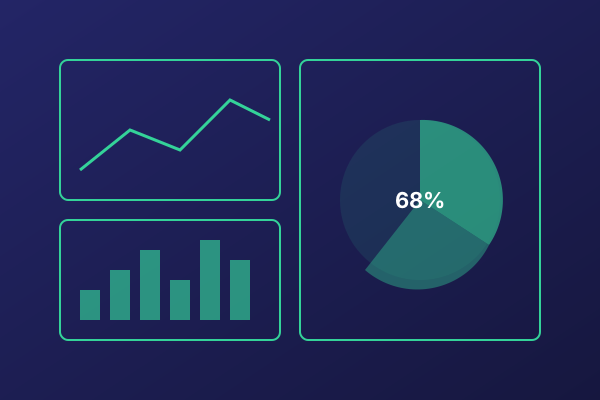
You have data, but you can't see it when you need it. Every meeting starts by asking for the number and ends debating where it came from. And the consolidated report arrives after the decision is already made.
We start from the questions you need answered, not the available data. We design dashboards that get used every Monday — not dashboards that get inaugurated and forgotten.
We list with you the decisions being made and the indicators that inform them.
We define how each indicator is calculated and unify the data so everyone looks at the same figure.
Each visualization answers a concrete question — no ornamental charts.
We iterate based on real use. Unused dashboards get removed.
Reproducible ETL/ELT processes, a data warehouse or data marts depending on scale, a semantic layer with single indicator definitions, and dashboards decoupled from logic so the same data serves multiple views.
Technologies we use
 Python
  PostgreSQL
  OpenSearch
  Power BI
  DAX
DAX  Grafana
  Apache Superset
  pandas Python PostgreSQL OpenSearch Power BI DAX Grafana Apache Superset pandas
 Systems for hospitals, ministries and healthcare networks: clinical records, epidemiological surveillance, program management, territorial KPIs.
Solutions for prevention, monitoring and response to emergencies: territorial intelligence, early indicators, inter-agency coordination.
Systems for environmental monitoring, forestry management, enforcement and impact reporting. Reliable data for both policy and operations.
Academic systems, learning platforms at scale, and portals for universities. Not corporate training: academic institutions with thousands of students.
For corporations and mid-market companies that need solid internal systems: automation, supplier integrations, executive dashboards, field apps.
We build the dashboard used every Monday at 9 — not the pretty one in the annual deck.
Let's talk